MONGOLIA CONTRIBUTES TO INTERNATIONAL PEACE AND SECURITY
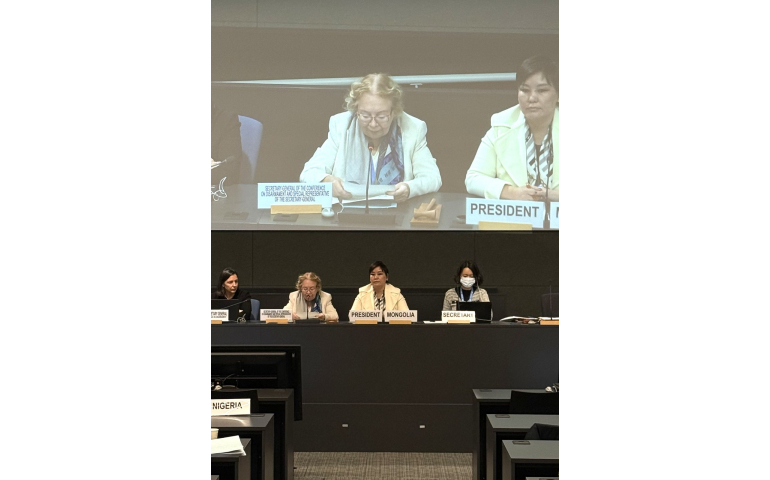
From 19 January to 13 February 2026, Mongolia held the Presidency of the Conference on Disarmament (CD). During this period, the Permanent Mission of Mongolia to the United Nations Office and other international organizations in Geneva worked actively to promote mutual understanding and build consensus among CD member states.
A distinctive aspect of this responsibility – an opportunity that arises once every ten years for each CD member state – was that, as the first President of the CD for the year, Mongolia facilitated the adoption of the Conference’s agenda and draft programme of work, as well as consideration of requests from observer states.
During Mongolia’s Presidency, the Conference adopted its agenda for the year and approved the participation of 16 states as observers in its activities. Mongolia also convened a formal plenary meeting among member states on pressing issues related to international peace and security. The participation and remarks of Mr. Thomas DiNanno, the United States Under Secretary of State for Arms Control and International Security, further highlighted the relevance and importance of the Conference.
Mongolia also made sustained efforts to advance the adoption of the draft programme of work, which has remained not adopted for the past 30 years due to divergent positions among member states. In this context, more than 20 bilateral meetings were held, along with ten rounds of informal multilateral consultations and eight formal and informal plenary meetings. Although consensus on the draft decision on the work of the Conference for 2026 was not reached, representatives of member states expressed appreciation for Mongolia’s responsible and proactive leadership during a particularly complex geopolitical period.
In line with its peace-loving, open, independent, and multi-pillar foreign policy, Mongolia fulfilled its responsibilities as President of the Conference on Disarmament in a constructive and principled manner. As a member of the international community, this represents a concrete contribution to addressing pressing regional and global challenges, particularly in advancing nuclear and other weapons of mass destruction non-proliferation and disarmament efforts.